You've made it to senior leadership. So why do some conversations still feel this hard?
There's a conversation you keep postponing. And the longer you leave it, the harder it gets, for them and for you.
You're in rooms where the stakes are high, the relationships are complex, and saying the wrong thing or nothing at all, costs more than most people realise.
Three free guides. For the conversations and rooms that matter most.
What does it look like when you get this right?
Your team People who trust you enough to tell you the truth. Feedback that actually changes something. No more conversations you wish you'd had sooner.
Your stakeholders Rooms you can read before they go wrong. Buy-in from people who didn't ask for your view. Influence that doesn't depend on your title.
Your reputation Known for saying the hard thing, not avoiding it. The leader people want in the room when it matters. Someone who makes things better, not just easier.

Nobody teaches you this clearly.
You learn it over time, by observing, by getting it wrong, by slowly working out what to pay attention to.
The workplace is too busy for anyone to sit you down and show you properly.
The leaders who get good at this have simply made more mistakes, learned from them, and shown up differently because of it.
These tools will not replace that experience. But they will show you what to focus on, what to notice, and where to start.
What’s inside the tools
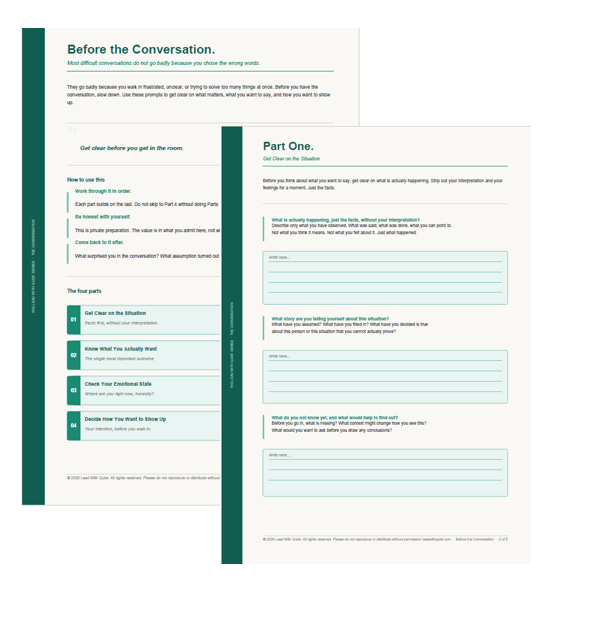
The conversation · Preparation
Before the Conversation
Get clear on the facts, your emotional state, and the single outcome you want — before you walk in.
Use when: you have a difficult conversation coming up and want to go in prepared, not reactive.
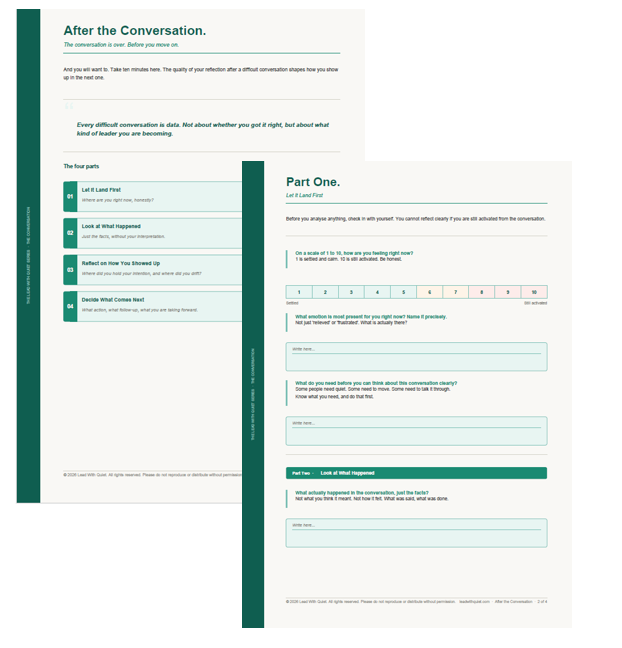
The conversation · Reflection
After the Conversation
Reflect on what actually happened, how you showed up, and what you are taking forward as a leader.
Use when: the conversation is over and you want to learn from it — not just move on.
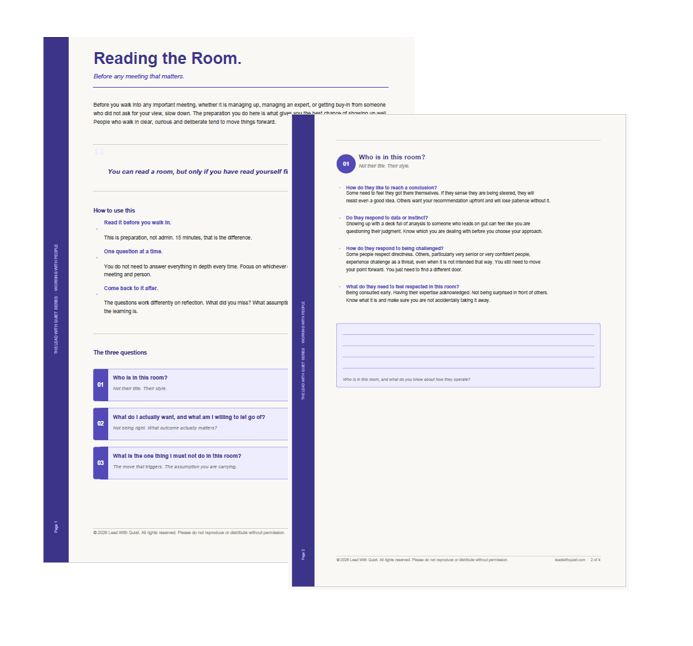
Working with people · Preparation
Reading the Room
Know who is in the room, what you actually want, and the one move you must not make — before any meeting that matters.
Use when: you are walking into a high-stakes meeting and want to show up clear, curious, and deliberate.
FAQ

-
A collection of practical tools for senior leaders that go deep on the conversations and rooms that matter most. Three free guides are available now, with more coming. A paid product is in development — subscribers get early access and the best price.
-
Before the Conversation — a preparation worksheet for any difficult conversation. Get clear on the facts, your emotional state, and the single outcome you want before you walk in.
After the Conversation — a reflection worksheet for when the conversation is over. Look at what actually happened, how you showed up, and what you're taking forward.
Reading the Room — a preparation guide for any high-stakes meeting. Know who's in the room, what you actually want, and the one move you must not make.
-
Senior leaders, directors and executives who manage teams and navigate complex stakeholder relationships.
-
The series is complimentary for now. A paid product is in development — subscribers get early access when it launches.
-
Yes, anytime.
Why I’m writing this series
When I was a director, I was told I needed to be more visible. More present. That I needed to show up differently with senior stakeholders.
I had no idea what that actually meant. And the people who were good at it made it look effortless, which made it even harder to reverse-engineer.
What actually helped me were the conversations with mentors, sponsors, and senior leaders who were willing to be specific. Who told me what they’d seen, what they’d done, and what had worked for them in the moments that counted.
If you’re a director or senior leader who’s ever felt confused, underestimated, or just quietly unsure of what you’re supposed to be doing differently — this is for you.
For the younger version of me. And maybe for you too.